How to improve feng shui in a rented home? An adjustment order that requires no renovation
KarmaSpace translation
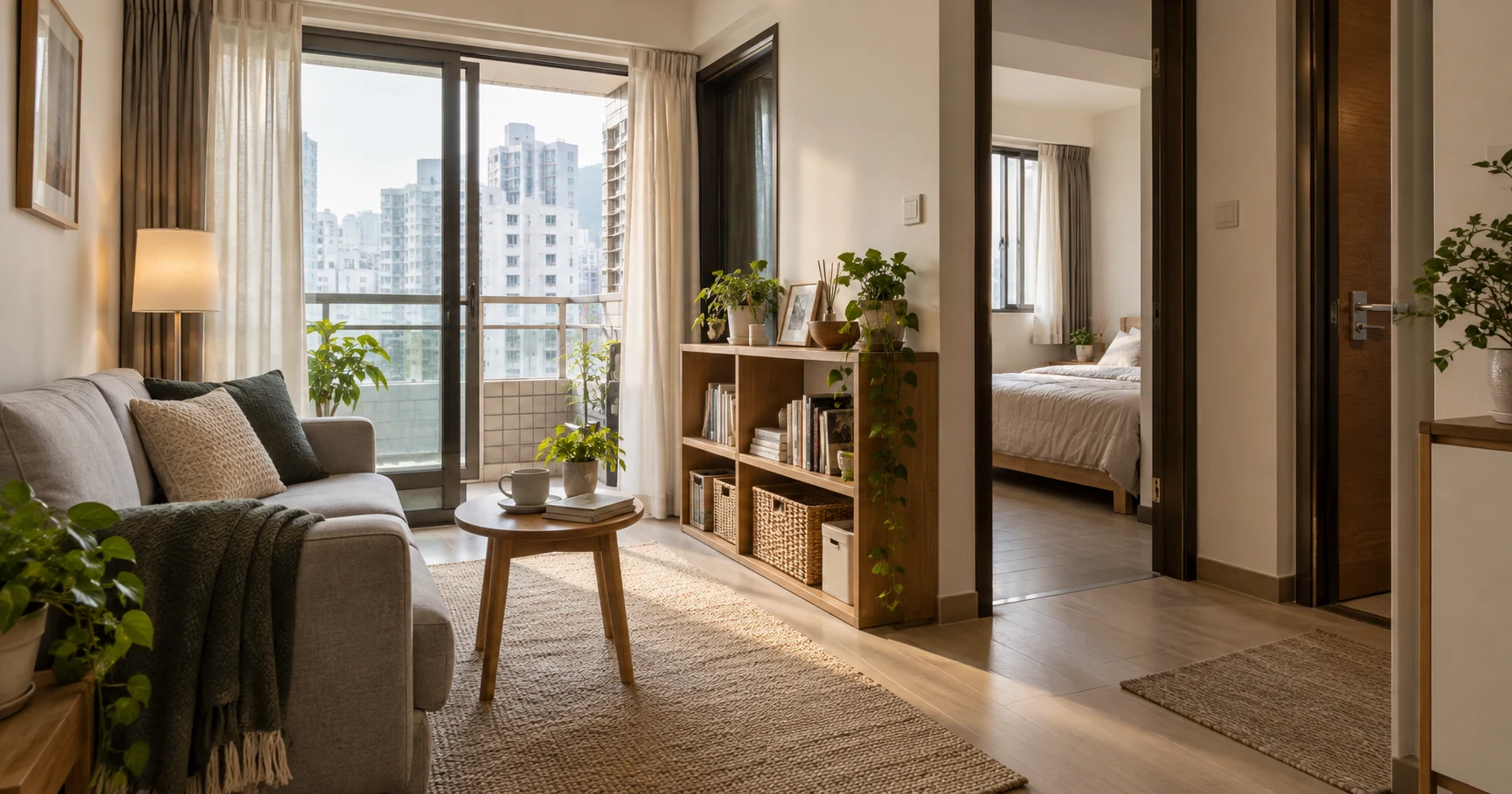
For a rented home, deal with visible problems first; don't buy ornaments right away
The most practical starting point for feng shui in a rented home is to ask which spot genuinely doesn't work well. A shoe cabinet that hits the door when it opens, people constantly walking behind you while you work, and a streetlight shining straight onto the bed at night are three different problems that need different responses. Lumping them together as "bad energy" actually makes it harder to find what can be adjusted.
This article treats feng shui as a cultural framework for observing space, and offers everyday arrangements you can compare for yourself. Improvements to movement flow can be observed; the claim that "after adjusting, wealth and romance will surely flourish" lacks sufficient basis, and the two should not be treated as the same kind of promise.
Step one: draw a sketch marking only the frequently used spots
No precise surveying is needed. First draw the main door, windows, bed, desk, sofa and main storage cabinets, and mark the routes you walk each day from the entrance to the kitchen, bathroom and bedside. Then write down the three most frequent annoyances, along with when they occur, for example "at 9pm, sitting on the sofa, the corridor light reflects onto the TV."
Write the constraints in too: which furniture is provided by the landlord, which cannot be moved, and whether hanging rails or drill-free fittings can be used. If fixed installations, electrical work or structure are involved, do not modify them yourself; confirm first with the landlord and qualified professionals. The purpose of the sketch is to narrow down the problem, not to judge the fortune of the whole flat from a single drawing.
Step two: clear the routes first, then deal with obstructions
Walk from the entrance to the most frequently used spots in the home, and try once carrying shopping bags, opening cabinet doors and pulling out chairs. If you have to turn sideways, move things or step around a low stool every time, remove these obstacles first. Don't add a screen at an already narrow entrance in order to "gather energy," and don't move items into the common corridor.
When more privacy is needed, first try curtains, a small change of furniture orientation, or a movable partition that doesn't block light. Confirm the fixing method and usage restrictions first, to avoid a tall cabinet working loose, furniture blocking doors or windows, or screening that actually makes the home harder to move around in. If the annoyance is a neighbour seeing straight into your home when they open their door, see separately how to judge door-facing-door.
Step three: change only one variable, and note different times of day
For example, first deal with the passage behind your work chair: turn the desk, or move the usual walking route to the side of the desk. Keep other conditions unchanged, and note whether you still often have to turn around or make way while working. This kind of comparison can tell you whether an arrangement is smoother to use; it cannot prove that a particular direction changed your fortune.
Lighting is the same. First check whether the light falls on the paper, the screen or your eyes, then try adjusting the lamp's position and the curtains. Don't shine strong light directly at a resting spot just because "a certain direction should be bright." For different desk situations, see desk placement and light source position.
One-week record sheet: what is worth keeping?
On day one, photograph the original state and list the single most troublesome thing. On day two, make only one reversible adjustment. From day three to day six, at similar times, note whether you still bump into the door, take detours, get glare or are interrupted, and also note whether family members find the space harder to use. On day seven, decide whether to keep, modify or revert. This is the observation process suggested in this article, not a research-validated feng shui test.
If after adjusting there is just one more ornament to look after and the original problem remains, there is no need to keep it. If the problem is a leak, odour, broken lock or persistent noise, deal with the property issue itself rather than substituting decorations for repairs. The most valuable improvement in a rented home is usually being able to say clearly "what has become easier to use."
Further reading and content notes
For entrances and storage, you can read next entrance arrangements; if the same room serves as both workspace and sleeping space, see zoning methods for small flats.
This article and its illustrations were produced with AI assistance and offer general space-organising suggestions; they are not an on-site survey, architectural design or personal fortune-telling conclusion, and the illustrations are not dimensioned drawings ready for construction. For decisions involving health, safety and finances, please rely on professional assessments and actual data.
常見問題
問If the bed can't be moved in a rented home, can it still be improved?
You can first deal with light blocking, the passage beside the bed, mirror reflections and nearby clutter, choosing reversible adjustments. Don't block doors or windows or force changes to fixed installations for the sake of a particular direction.
問Does feng shui in a rented home require buying crystals or screens?
Not necessarily. First confirm whether the annoyance is privacy, movement flow, glare or storage; if there is no corresponding problem, buying more ornaments may not help, and certainly cannot guarantee a change in fortune.
問How long after making adjustments can you know whether they have worked?
Detours in daily life, glare or conflicts over use can be compared in similar situations. This article suggests recording for one week to help organise observations, but this is not a deadline for fortune to take effect, nor can it verify any wealth-attracting effect.