Does a main door facing a main door need resolving? First distinguish which kind of door-facing-door it is
KarmaSpace translation
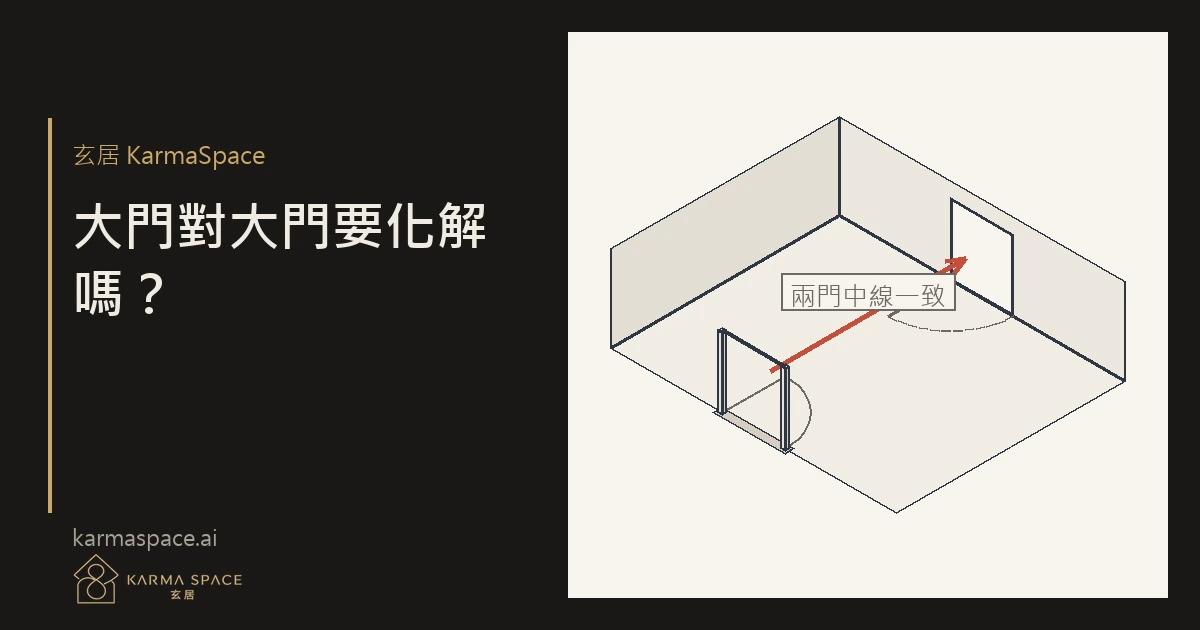
Main door facing main door means your main door and the neighbour main door face each other directly across the corridor. It does not necessarily need resolving in itself. Look at three things: whether the centre lines of the two doors are on the same straight line, how narrow the corridor is, and whether, when both sides open their doors at the same time, you can see straight into the other home.
The traditional saying calls this duimen sha, and some also call it ma men, meaning the two households are prone to quarrels. Put in terms of what can be observed, it is that the coming and going, the sounds and the sightlines of the two households overlap at the same point: when you open your door, the other side may also be opening theirs, and the two families come face to face in the corridor.
In Hong Kong, many public housing and older estate units are arranged along both sides of a corridor, and door facing door is almost the standard layout, so moving home does not necessarily avoid it. So this article focuses on what can be done after moving in.
What kinds of door-facing-door are there?
The first kind is directly facing: the two doors are similar in width, their centre lines are on the same straight line, and when the doors are open you can see straight into the other entrance hall. This is the kind most often mentioned traditionally.
The second kind is offset: the two doors face each other, but their centre lines are offset by more than half a door width. When the doors are open, what you see is the other door frame or wall, not the interior. In this layout the overlap of sightlines and movement paths is much less.
The third kind is inside the home: the main door facing a room door, or a room door facing a room door, or a room door facing a toilet door. This is a different problem from two units facing each other, and the focus is on the movement paths inside the home. If the main door also faces a window or balcony directly, it falls within the scope of Chuantang Sha.
What does main door facing main door actually affect?
What can be observed is mainly two things. The first is privacy. When two units face each other directly and the corridor is narrow, whenever either side opens the door, the other can see into your entrance hall, or even your living room, just by standing at their door. You may not mind, but before opening the door each time you will unconsciously listen first to check whether anyone is in the corridor.
The second is collisions when coming and going. The two families have similar times for work and school, so when the doors open they may coincide, and you have to give way and greet each other, several times a day. This is not a bad thing, but it does add a pause to going in and out.
Online you often see claims that door facing door affects health or harms wealth; these have no measurable basis. What can be stated clearly is privacy and movement paths, and both can be judged for yourself and handled for yourself.
Does main door facing main door always need resolving?
If the two doors are offset, or the corridor is wide enough that you cannot see into the other home when the doors are open, usually no special handling is needed.
If the two doors face each other directly, and when you open your door the other entrance hall is fully visible, the focus of handling is the sightline, not blocking sha. Think of it the other way: when the other side opens their door, they can also see into your home, and this is the same for both sides.
If you already feel uneasy when entering, first distinguish the cause: is it the sightline from the corridor, or a problem with the entrance hall itself. For what you see at first glance when entering, the article Entrance First Glance breaks it down in more detail.
Ways to handle it without renovation
First, hang a door curtain on the inner side of the main door, or place a half-height entrance cabinet. When the door is open, what the outside sees is the curtain or the cabinet body, not your living room. This is the most direct step for privacy, and it does not affect the neighbour.
Second, adjust your door-opening habits. Open the inner door first, confirm no one is in the corridor, then open the metal gate, or open only the metal gate without fully opening the wooden door. This greatly reduces the chances of the two families coming face to face.
Third, deal with the lighting at the door. When the corridor light is dim, the two households pay more attention to each other movements when opening their doors. Add a sensor light inside your own door, so the entrance hall lights up first when you come in, and you do not have to feel for the switch in the dark.
Traditional practices also include hanging a bagua mirror at the door, placing lions, or pasting spring couplets. With these practices, note one point: a convex mirror or a mirror surface facing the neighbour main door directly easily causes disputes in public housing and estates, and the deeds of some estates do not allow objects to be placed in public corridors. Confirming the management office rules matters more than which object to choose.
How can you check before moving home?
When viewing a flat, open the main door and stand at the doorway, and see whether what is opposite is a door, a wall or a window; then stand at the opposite position and look back, to confirm how much of the interior can be seen from the corridor. These two actions need no tools and take one minute.
If the two doors face each other directly, then look at the width and lighting of the corridor. A wide corridor with ample light makes the effect much smaller; a narrow, dark corridor means you should set aside a spot for an entrance cabinet.
One question we have not settled is: along the same corridor, how much does the experience differ between two directly facing units and two diagonally facing units. This needs more feedback from actual residents, and we are still collecting it.
常見問題
問What does a door facing a door mean?
Main door facing main door means your main door and the neighbour main door face each other directly across the corridor, traditionally called duimen sha. What can be observed is that the coming and going, the sounds and the sightlines of the two households overlap at the same point.
問Does main door facing main door always need resolving?
Not necessarily. If the two doors are offset from each other along the centerline, the corridor is wide enough, and you cannot see into the other home when the door is open, usually no special handling is needed. When the two doors face each other exactly and you can see into the other entryway, the focus of handling is the line of sight.
問What is the simplest way to handle a door facing a door in public housing?
Hang a door curtain on the inner side of the main door or place a half-height entryway cabinet, so that when the door opens, what is seen from outside is the curtain or the cabinet rather than the living room. This requires no renovation and does not affect the neighbors.
問Can a bagua mirror be hung at the door facing the neighbor door?
Be careful. A mirror facing a neighbor main door directly tends to cause disputes in public housing and housing estates, and the deeds of some estates do not permit placing objects in public corridors, so confirm the rules with management first.