What is a piercing hall sha? How to judge it, and ways to deal with it without sealing the windows
KarmaSpace translation
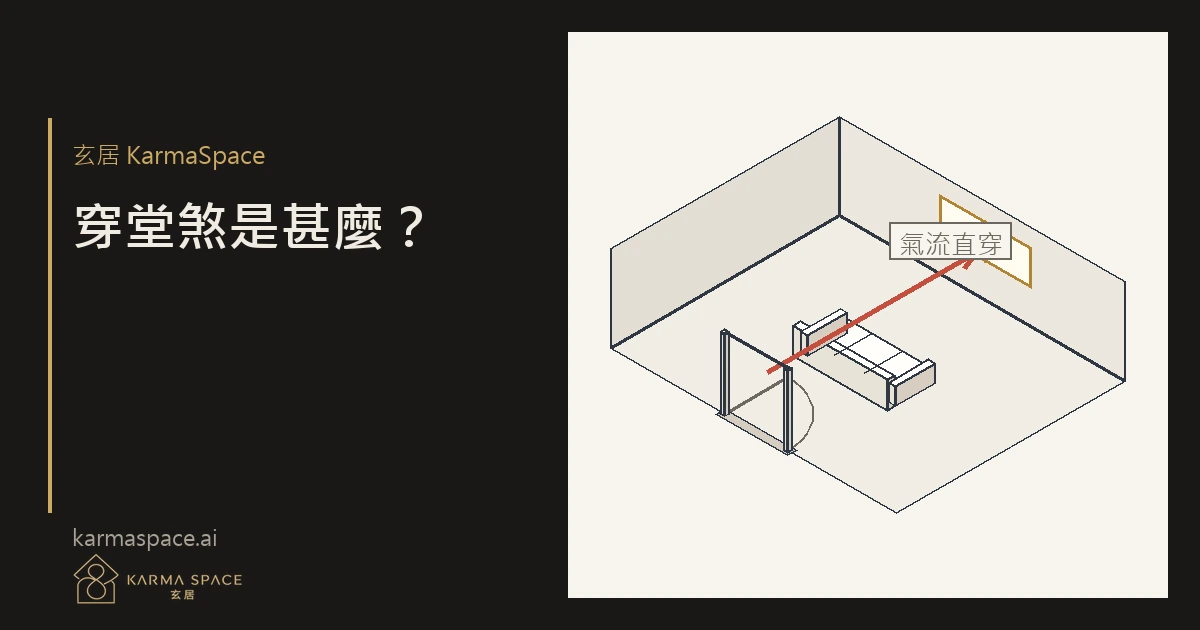
A piercing hall sha means the main door and the window opposite, a balcony door, or a back door fall on the same straight line, with nothing blocking the middle, so that when opened, the wind runs from the entrance all the way through to the other end. The traditional saying is that "qi does not gather"; put in terms of what can be observed, it means that when there is wind, a stream of air appears inside the home running straight from the entrance to the opening opposite, and it passes right through the middle section of the home.
To judge it, look at three things: whether the two openings are on the same axis, whether furniture or a wall blocks the middle, and whether this line passes through where you often sit or sleep. Only when all three hold is it a piercing hall sha that needs dealing with.
This article will not tell you to seal up the window; instead, it explains how to move that line away from where people stay.
How do you judge whether your home has a piercing hall sha?
The most direct way is to stand outside the main door, open the door and the window opposite at the same time, and see whether your line of sight can reach all the way to outside the window. If you can see the sky or the building opposite, with nothing blocking the middle, the two openings are on the same axis.
The second step is to stand in the middle of this line on a windy day and feel it. The wind blows straight from the doorway to the window, and paper on the table gets blown about; these are signs you can observe directly.
The third step is the one most often overlooked: see what this line passes through. If it only crosses a corridor where people rarely stay, the effect is small; if it passes right through the sofa, the dining table, or the bed, then on windy days you sit in this airflow for several hours every day.
A layout where only the first step holds and the third does not is still traditionally called a piercing hall sha, but in terms of actual living, it can be dealt with later in order of priority.
What does a piercing hall sha actually affect?
There are mainly three observable effects. The first is airflow: with nothing blocking the straight line, the wind blows all the way to the other end, and people sitting on the line feel wind blowing constantly, especially in winter. The second is doors: wind pressure can make room doors suddenly slam shut, which is loud and can easily catch fingers.
The third is sightlines. As soon as the main door opens you see outside the window, with nothing in the home to pause the eye, and this is the same thing discussed in the article on the first glance on entering the home: the line of sight runs straight out, and people coming in do not easily get the sense of switching to "I am home."
Many articles online link a piercing hall sha to "leaking wealth" or health problems. These claims have no measurable basis, and we do not write that way. What can be stated clearly is the three things you can observe tonight: airflow, doors, and sightlines.
Must a piercing hall sha be remedied?
Not necessarily. First look at what that line passes through. If no one stays on the line for long, and most of the time only one side of the door and window is open, so the straight airflow rarely appears, you can leave it for now.
Conversely, if the sofa or bed is right on the line, or children in the home play on this line, there is good reason to deal with it. What needs dealing with then is not the wind itself, but the relative position of people and wind.
There is another situation to consider separately: a main door facing a main door. Two households whose main doors face each other across a corridor is a different problem from a piercing hall inside the home; for details, see the article Does a door facing a door need remedying?.
Without sealing the window, how can it be dealt with?
First, add a half-height screen on the inner side of the main door. An entrance cabinet, a folding screen, or a tall bookshelf will do; it does not need to reach the ceiling. The wind has to go around it to continue forward, and people sitting behind it no longer face the wind directly, while ventilation is still preserved; whether it is tall enough can be judged with the tissue test in the last section.
Second, move the furniture on the line, not the door and window. Move the sofa or dining table one body-width off the axis, and people no longer sit in the draft. This is the same principle as in a sofa directly facing the main door: offset it, do not block it completely.
Third, deal with the doors. Add a door stop or a buffer to the room door, and no matter how strong the wind pressure, it will not slam shut. This is the lowest-cost, most direct step.
Fourth, control when and how wide you open the window. Open the door and window at the same time only when you need ventilation; ordinarily open only the window and not the main door, and the straight airflow will not appear.
A test you can do yourself
On a windy afternoon, open the main door and the window opposite at the same time, place a paper tissue every two steps along this line, and see which ones get blown. The range that gets blown is the area actually affected.
Then place a temporary screen on the inner side of the main door, such as an open suitcase or a folded ironing board, and look again. If the tissues no longer move, a half-height piece of furniture is enough, and there is no need to renovate for this.
There is one point we do not yet have an answer to: the through-draft on high floors and low floors feels very different, but we do not yet have enough on-site measurements to say clearly how much it differs.
常見問題
問What does Chuantang Sha mean?
Chuantang Sha means the main door and the window, balcony door or back door opposite are on the same straight line, with nothing blocking in between, so that when opened the wind passes from the entrance all the way through to the other end. The traditional saying is that qi does not gather; what can be observed is that when there is wind, an air current runs through the home in a line from the entrance straight to the opening opposite.
問How do you tell whether your home has Chuantang Sha?
Look at three things: whether the main door and the opening opposite are on the same axis, whether there is anything blocking in between, and whether this line passes through a spot where you often sit or sleep. Only when all three hold is there a need to deal with it first.
問Must a piercing hall sha be remedied?
Not necessarily. If no one stays on the line for long periods, and the doors and windows are rarely opened at the same time, you can leave it for now. When the sofa or bed is right on the line, there is a stronger reason to deal with it.
問Does resolving Chuantang Sha require sealing up the window?
No need. Add a half-height screen on the inner side of the main door, so the wind has to go around it to continue forward; the people sitting behind it no longer take the wind head-on, and ventilation is still preserved. You can also move the sofa or dining table on the line aside by one body width, and add a door stop to the room door.