Exposed beam overhead: what exactly is that line above your head affecting
KarmaSpace translation
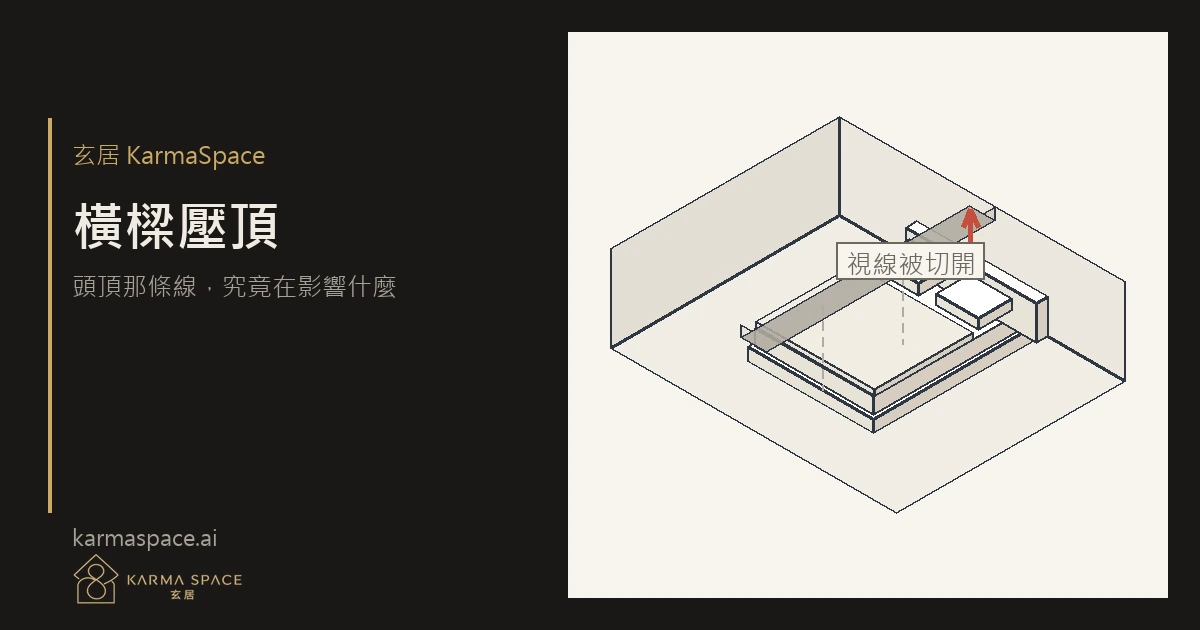
A beam overhead means a beam or a ceiling height difference directly above a bed, desk or sofa. What it actually affects is the line of sight: an extra continuous edge line above the head, on which attention keeps a share. The order of handling is first to move the furniture out from under the beam, second to turn it ninety degrees so the beam falls to the side, and only if neither is possible to consider boxing the ceiling flat.
A beam overhead is probably the easiest thing in feng shui to point out. If a room has a beam and a bed or desk is placed under it, an elder or a designer will mention it. The explanation usually stops at qi being pressed down, and then there is nothing more.
Unpack that statement, and what it actually describes is a fairly concrete situation: above the spot where you spend long periods of time, there is a protruding structure running across in a certain direction. It is not mysterious, and it does not need to be explained by energy.
What is really worth asking is this: the same beam, so why does one person live with it without issue, while another feels stifled the moment they lie down. The difference is not in the beam itself, but in the relationship between the beam and the person.
First, identify which kind of beam it is
The first kind is a structural beam, of concrete or steel, clearly thick, exposed beneath the ceiling. This kind of beam will not disappear; you can only avoid it or encase it.
The second kind is a false beam created by encasement. There was no beam originally, but to conceal pipes or create a design feature, a dropped section of woodwork or light steel framing is built. It is usually thinner than a structural beam, but the horizontal line it creates is just as clear.
The third kind is the easiest to overlook: it is not a beam, but a difference in ceiling height. For example, a partial drop above the head of the bed, or a fold line formed by boxing in an air conditioner pipe. It does not carry the name of a beam, yet it produces the same visual effect.
The three are handled differently. A structural beam means either moving the furniture or boxing the ceiling flat; a false beam can be removed; a height difference can usually be resolved by changing the lighting or changing the bed position. First see clearly which kind it is, then decide whether to act.
When there is a line in your line of sight, your attention gives it a share
Lying on the bed and looking up, if there is a horizontal beam directly above, your field of view gains an extra boundary. It is not decoration; it is a physical edge that cuts the ceiling in two.
People are naturally more sensitive to things above their heads. This does not need to be explained by evolution or instinct; you need only recall walking into a low parking garage, or sitting beneath a low door frame, and your body naturally draws in slightly.
The beam is not necessarily low enough to bump into, but it persists at the edge of the line of sight. You think you have relaxed, yet your attention keeps a share on that line. This is a common sensation when lying down with the gaze turned upward; it is personal bodily feeling rather than a measurement result, and you can try it yourself tonight. A living room sofa with nothing behind it is the same thing, except that the line moves from above the head to behind the back.
So the word pressed is less about qi being pressed than about attention being occupied. It is not an illusion, nor some mysterious force; it is simply a continuous visual reference. The same mechanism appears at the entrance hall: a mirror seen the moment the door opens, the gaze is pulled away first, and the body pauses after it.
Beds and desks are not the same situation
The problem with a bed is the long time spent there, and the posture of lying flat. When lying flat, the gaze goes upward, and the beam falls right in the center of the field of view. It is in the last image you see before closing your eyes, and it is also in the first image when you open your eyes after waking in the night.
The problem with a desk is not lying down, but that when seated the gaze goes forward, while the beam forms a pressing edge above and ahead of the head. If the desk is against the wall and the beam is directly above the front of the desk, you will feel the desktop is framed in.
The difference between the two is this: the effect of the bed leans toward the sensations before sleep and after waking, while the effect of the desk leans toward the bodily feeling during daytime work. The same spot, used for sleeping at night and working by day, may feel completely different.
This is also why moving furniture is often more practical than removing a beam. Most people will not alter the structure for the sake of a beam, but they can choose not to place the bed or desk directly beneath it.
Three things you can do yourself
First, measure. Take a tape measure and measure the height from the underside of the beam to the floor, then measure the height from the top of your head to the floor when you are sitting or lying down as usual. If the difference between the two is less than a fist (held upright, about ten centimeters), that beam has truly entered your main field of view.
Second, change the direction. The bed or desk does not necessarily need to be moved out of the whole room; sometimes simply turning it ninety degrees turns the beam from directly overhead into something at the side. A beam at the side has a much lower presence in the mind.
Third, box the ceiling flat. If the position of the beam cannot be changed, and you must spend time there, lower the ceiling together with the surrounding area to box it flat, so that the line disappears. The cost is a lower ceiling, but what you gain is a complete plane.
None of these three things requires choosing an auspicious date, nor any tools. Before you lie down tonight, one glance upward will tell you which kind you belong to.
A question with no standard answer
The same beam: some people are completely unaffected, while others feel something is off the moment they lie down. There is no uniform threshold in between, and no single line that applies to everyone.
If you are currently troubled by a beam in your room, you can first do one thing: move the bed out from under the beam, sleep that way for a week, then move it back and sleep that way for a week. Whichever week you find it easier to relax, you will have your own answer.
Do not rush to demolish, and do not rush to believe. First let your body tell you whether that line has actually entered your line of sight.
常見問題
問What kinds of beams are there in a room?
The first kind is a structural beam, of concrete or steel, clearly thick, exposed beneath the ceiling; it will not disappear, and you can only avoid it or encase it. The second kind is a false beam built to conceal pipes or create a design feature, and it can be removed. The third kind is a difference in ceiling height, such as a partial drop above the head of the bed or a fold line formed by boxing in an air conditioner pipe; it does not carry the name of a beam, yet it produces the same visual effect.
問What does a low beam overhead actually affect?
Lying in bed and looking up, if there is a horizontal beam directly overhead, your field of view gains a solid edge that cuts the ceiling in two. The beam may not be low enough to bump into, but it persists at the edge of your vision, and a share of your attention stays on that line. So the pressure it exerts is less about qi being pressed and more about attention being occupied.
問How do you judge whether a beam has entered your main field of view?
Use a tape measure to measure the height from the bottom of the beam to the floor, then measure the height from the top of your head to the floor when you normally sit or lie down. If the difference between the two is less than one fist (held upright, about ten centimeters), that beam has truly entered your main field of view.
問If the bed or desk is under a beam, what can be done without removing the beam?
The bed or desk does not necessarily have to be moved to another room; sometimes simply turning it ninety degrees changes the beam from directly overhead to the side, and a beam at the side has a much weaker presence in your awareness. If the beam cannot be moved and you must remain in that spot, you can lower and box in the beam together with the surrounding ceiling to make it flat, at the cost of a lower ceiling in exchange for one complete plane.