Why was Wan Chai Hung Shing Old Temple built beside a rock? Reading the old coastline and temple layout along Queen's Road East
KarmaSpace translation
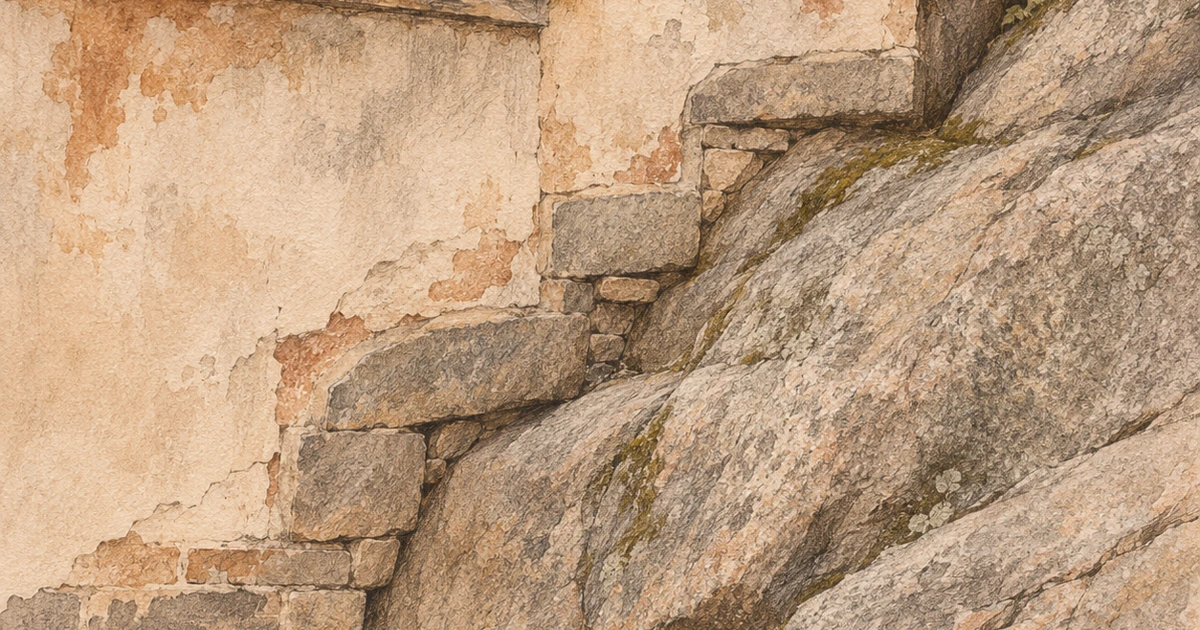
New material from 11 month discusses how the old temple was built against the rock
Diagram of the junction between the wall and the natural rock surface. For the old temple's actual layout, please refer to the Antiquities and Monuments Office and Hong Kong Government News website materials.
On 2026 year 11 month 21 day, the Hong Kong Government News website published a feature on Wan Chai Hung Shing Old Temple. A government press release at 10:17 that day confirmed that the text and video had been uploaded. The feature interviewed representatives of the Antiquities and Monuments Office and the temple, beginning with the rock face, the coast and community worship. The gazettal date of the declared monument was 10 month 2 day of the same year. The Antiquities and Monuments Office estimated the construction date as between 1847 and 1852. These three sets of dates concern, respectively, the new report, the statutory status and the building's history. [Sources 1–4]
In the feature, a curator of the Antiquities and Monuments Office pointed out that the temple wall was built along the undulating natural rock surface, making the giant rock a visible part of the temple interior. To see this craftsmanship, note where the wall surface ends and where the stone surface continues. Then return to the porch and see how the front porch is entered and exited from both sides, and how the columns, beams and railings each define space. The two places show different design decisions: one is the junction between wall and terrain, the other is the arrangement of the entrance. [Sources 1, 4]
Locate it using today's streets, then add the old coastline back
The Tung Wah Group of Hospitals' architectural material describes the old temple's predecessor as a small altar on a rock facing the sea. The old temple is now located at 129 Queen's Road East. Reclamation changed the land-sea boundary, and the temple once near the shore now stands within a street block. The government feature also mentions that Tai Wong East Street and Tai Wong West Street are named after "Tai Wong", an alternative name of Hung Shing Old Temple, so the street names become a clue for recovering local religious memory. [Sources 1, 5]
When reading new and old maps, first mark the old temple, then choose dated old maps to compare the coastline in the same area. Walk a stretch of Queen's Road East, observe the relationship between the existing streets and the temple entrance, then turn back to the maps to see what would have been visible out to sea in the past. To ask further in what period the temple changed from being by the sea to being on an inner street, compare reclamation areas by different years. Today's traffic lanes alone cannot establish the relationship between the nineteenth-century entrance and the sea surface.
Understand the site through Hung Shing belief, and examine feng shui through historical sources
The Antiquities and Monuments Office records Hung Shing as the god of the South Sea in traditional belief. The government feature also mentions that fishermen and maritime traders in the past worshipped Hung Shing. In its early period, the old temple allowed worshippers to place ancestral tablets, so it was also connected with the worship of neighbourhood families. To consider the temple's cultural value, one can ask both what those who made a living at sea sought and how land-based neighbours used the temple in daily life. [Sources 1, 4, 5]
When feng shui discusses configuration, it often starts from the relative positions of mountains, water and buildings. From this angle, one can first ask where the rock, the old shore and the entrance are, then ask who proposed at what time that "a certain layout has a certain meaning". To attribute a particular account to the temple's builders, contemporary written records, temple steles or traceable oral materials would be needed. The available materials can support that the old temple adapted to the rock and was originally at the shore, but there is still no direct record of whether the builders adopted a specific feng shui method.
What three places can you look at first on site?
The first is the street in front of the temple. First locate yourself on the public pavement and check against the street name and number. The second is the porch. Note the passages on both sides and the granite components, and leave the entrance and exit to worshippers. The third is the visible junction between wall and rock. Depending on the temple's arrangements that day, observe only from places where entry is permitted. Before taking photographs, check on-site instructions, and in particular do not photograph people who are worshipping. [Sources 1, 4, 5]
The same street number also appears in the Tung Wah Group of Hospitals' material on Pak Shing Hau Temple. When checking conservation status, verify by building name: the statutory status of Hung Shing Old Temple appears in the government notice of 2026 year 10 month 2 day, while Pak Shing Hau Temple's Grade II historic building rating has separate material. [Sources 3, 6]
To compare terrain clues in rural areas, you can read further Pat Heung Lin Fa Tei feng shui pond and Chik Kwai Study Hall, practising the same method of verification with the pond at the village entrance, the house clusters and the study hall.
Common questions
QDid the Hung Shing Temple only become a declared monument on 11-21?
The declaration of the monument was gazetted on 2026-10-2. What was released on 11-21 was a government feature introducing the temple's architecture and the old Wan Chai shoreline.
QDoes building against the rock mean the temple used a particular school of feng shui?
Currently available public materials can be used to verify the junction between the temple and the rock, and also to verify that the temple was formerly near the sea. To identify a specific geomantic practice, records traceable to the temple's construction period or renovation process are still needed.
QCan the former shoreline still be seen beside the temple today?
What lies directly opposite the temple is now a post-reclamation street block. To understand the location of the old shore, dated maps can be compared with the temple, Queen's Road East and nearby streets.
QCan photographs be taken at the temple?
First follow the temple's instructions for that day. If the entrance is busy or people are worshipping, you can first observe the exterior from the public pavement and stay in positions where passage is permitted.
Sources
- Hong Kong Government News Network|Temple and Rock in Symbiosis: A Treasure in the Bustling City · Published on 2026-11-21. Interviews with representatives of the Antiquities and Monuments Office and Tung Wah Group of Hospitals explain the relationship between the natural rock and the temple walls, the former shoreline and the temple's direction in promoting culture.
- Government Press Release|Announcement of the Upload of the "Temple and Rock in Symbiosis" Feature · Published on 2026-11-21 10:17 (Hong Kong Time), confirming that the text and video were uploaded on 11-21.
- Government Press Release|Two Historic Buildings Declared Monuments · Published on 2026-10-2 11:05 (Hong Kong Time), confirming the gazettal on the same day, the estimated construction period of the Hung Shing Temple and its architectural features.
- Antiquities and Monuments Office|Hung Shing Temple, Wan Chai · Standing information on the declared monument; the page does not list a publication time. Used to verify the temple and natural rock, its sacrificial use and the 1909 Shiwan ridge ornament.
- Tung Wah Group of Hospitals Archives and History and Culture Office|Hung Shing Temple, Wan Chai · Standing architectural information; the page does not list a publication time. It records the altar on the sea-facing rock, the change in location after reclamation and the address at 129 Queen's Road East.
- Tung Wah Group of Hospitals|Pak Shing Temple, Wan Chai North, Listed as a Grade 2 Historic Building · The announcement records that the Antiquities Advisory Board approved the Grade 2 rating for Pak Shing Temple on 2025-12-11. Used to distinguish between the monument and historic building information at the same site.
- RTHK|Government gazettes Wan Chai Hung Shing Temple and Stanley Mosque as declared monuments · Reported on 2026-10-2. Cross-checked against the gazette of that day and the background of the temple.