Man Mo Temple and Lit Shing Kung announce Dingwei incense bidding: prayers, charity and applications
KarmaSpace translation
What is newly announced? First distinguish the publication date from the year of offering
On 2026-10-28, the Tung Wah Group of Hospitals Temples and Cultural Promotion Service website published two announcements for the first lunar month of the Ding Wei year regarding large spiral incense placement bidding at Man Mo Temple and Lit Shing Kung. Both original pages include dates but no publication time. This article rechecked the original text on 10-30. This is an advance announcement of arrangements for offering during the next year's Lunar New Year; because it is still 2026, one should not mistakenly use the previous year's Bing Wu year forms.
According to the two announcements, Man Mo Temple has 30 places on the first day of the first lunar month and 23 places on the fifteenth; Lit Shing Kung has 10 and 16 places respectively. The base bid for both is HKD 600. These are limited quotas for different temples and different periods, and the base price is not a guaranteed winning bid price; do not treat the four sets of quotas as a single common list that can be freely exchanged. The [Man Mo Temple announcement](https://temples.tungwahcsd.org/latest-events/detail?id=3171) and the [Lit Shing Kung announcement](https://temples.tungwahcsd.org/latest-events/detail?id=3172) should be read separately.
More than a row of pagoda incense: the community background of the Man Mo Temple complex
The Antiquities and Monuments Office records Sheung Wan Man Mo Temple as a building complex composed of Man Mo Temple, Lit Shing Kung, and the Kung Sor, completed around 1847-1862 and listed as a monument in 2010. The Kung Sor was once used by Chinese residents for meetings and dispute mediation. This background reminds us that temples carry not only individual prayers but also how a community gathers, coordinates, and sustains public life.
From this perspective, when reading the placement bidding announcements, what is worth noting is how wishes are placed into a shared procedure: how limited places are allocated, which application is valid, and when payment is notified. This is the cultural reading angle of this article; it is not a judgment of any participant's motives, nor does it claim that every historical custom can be explained in the same way.
The symbolism of pagoda incense and the rules of bidding must be understood separately
In Tung Wah Group of Hospitals' introduction to pagoda incense service, incense is described as a messenger incense that conveys prayers, and the round pagoda shape is connected with a longer burning time. This is the organizer's explanation of the meaning of the folk belief. This article has not measured burning duration, nor does it turn a longer time into a stronger prayer effect.
This announcement also states that the proceeds from the bidding will be used as Tung Wah donations. The cultural prayer, the resource-based bidding, and the use of charitable funds are three levels that can coexist but cannot replace one another. A bid determines the chance to obtain a place according to the rules; the announcement provides no evidence linking bids to examination, income, health, or relationship outcomes. Do not read the amount as a score of personal fortune.
When preparing an application, the two most easily confused points
The first point is the form and its delivery. Both announcements require the original numbered bidding form. For in-person delivery, place it in the collection box at Man Mo Temple before 6 p.m. on 2026-11-23. Postal forms must arrive before 11-23; the posting date is not the arrival date. When requesting a form, specify the temple and period, then check eligibility, the address and the required envelope wording against that announcement. Do not substitute an old form found online.
The second is application and payment. The announcements state that no bid deposit or fee needs to be submitted together with the form; after shortlisting, Tung Wah will individually notify payment and issue an official receipt. When receiving payment reminder messages, first return to the original announcement and verify with the organizer, then handle according to the official notice. This is a verification method proposed according to the announcements; it does not mean that fraud has currently occurred.
Writing administrative dates into the calendar is more practical than guessing an auspicious hour
The two announcements list that the shortlist will be announced at the temple on 2026-12-1, and require shortlisted applicants to complete registration and payment at Man Mo Bie Yuen before 12-16. The latter item does not specify a deadline time in the content read for this article; time should be reserved to confirm with the organizer, and it should not be interpreted on one's own as still being possible late at night on 16. This article does not provide form-filling, submission, or payment collection services on behalf of others.
First arrange the four steps of requesting the form, submitting it, checking results, and following up on notices, then consider personal habits; this will make it easier to reduce omissions. Even if family members value the Tong Sheng, one should not miss administrative deadlines waiting for a particular time. Further reading: Meanings and scope of use of each item in the Tong Sheng auspicious and inauspicious almanac: traditional terms on the calendar cannot replace the organizer's receipt requirements for this event.
Before taking part, first think clearly about what you want to leave behind
You can start by stating your purpose for taking part in one sentence: is it to continue a family habit, to write down a blessing for your family, or to support charity? Then choose the expenditure and form of participation you can accept. Not securing a place does not need to be interpreted as being unblessed; securing a place also does not guarantee any outcome for your future life. These are the editorial team's suggestions in this article, not additional eligibility rules set by the organiser.
If your interest in temple culture comes from fortune slips, you may also read The different reading levels of slip text, interpretations and allusions. Pagoda incense and drawing fortune slips are different practices; what is worth practising in common is separating the source of the text and its symbolism from the inferences you make yourself, rather than rushing to find an answer of good or bad fortune in every detail.
Editorial and image notes
This article was researched and written by the 玄居 KarmaSpace editorial team with AI assistance, compiled from the organiser's announcements and government heritage materials, without on-site interviews. The folk belief content is for cultural understanding and does not constitute any personal fortune, health or financial guarantee. The information was checked on 2026-10-30; before taking part, please check again whether the organiser has revised the arrangements.
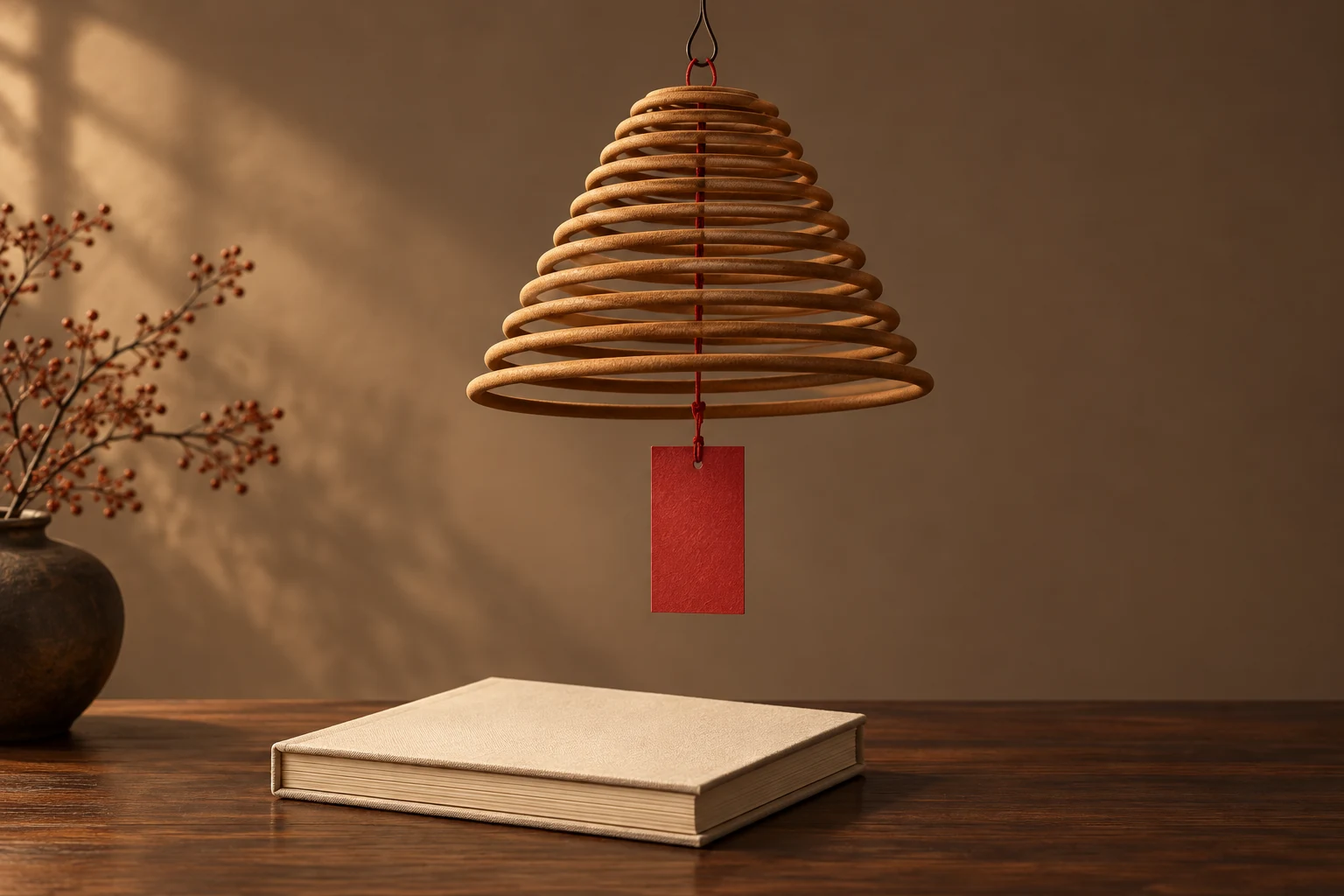
The accompanying image is an original cultural concept illustration; the pagoda incense, blank wish cards and calendar in the picture are not the temple site or an official bidding plan, and do not indicate actual hanging positions or bidding forms. This article does not reproduce photographs from the organiser or the media.
常見問題
問Is this announcement the arrangement for 2026 or for 2027?
The original was published on 2026-10-28, and the content concerns the bidding arrangements for large pagoda incense for the first and fifteenth days of the first lunar month of the Ding Wei year. Please request the form for the relevant occasion according to the Ding Wei year and the temple you choose, and do not mix in old materials from the Bing Wu year.
問Does paying 600 yuan guarantee a place?
600 yuan is the base bidding price listed in the two announcements, not a fixed sale price guaranteeing a place. The number of places, shortlisting and allocation are handled according to each announcement; do not treat the bid amount as a comparison of prayer efficacy or blessings.
問Is payment required when submitting the form?
The two announcements state that the bid amount or fee does not need to be paid together with the submission of the form; Tung Wah will notify shortlisted applicants individually to pay and issue an official receipt. If in doubt, return to the original announcement and verify with the organiser.
問For postal submission, is it enough to send it on 11-23?
It cannot be understood this way. The announcement says arrival by post before 2026-11-23, not dispatch on that day; allow time for postage. In-person submission is separately listed as before 6 hours in the afternoon of that day; do not confuse the two methods.
問Is bidding for pagoda incense the same as doing feng shui or changing one's fate?
This article discusses temple folk beliefs, charitable purposes and allocation of places. These are not the same as residential surveys or BaZi chart readings, and there is no evidence that a bid can guarantee a change in a person's real-world outcomes.
資料來源
- Tung Wah Group of Hospitals: Announcement of the public bidding method for large pagoda incense for the first and fifteenth days of the first lunar month of the Ding Wei year at Man Mo Temple · Organiser's original text, published 2026-10-28, no time given; viewed and re-checked 2026-10-30. The bidding concerns the first lunar month of the Ding Wei year; the application, announcement and registration schedule falls in 2026 year, months 11 to 12. Checked the number of places, base price, original form, arrival-by-post requirements and the procedure for notification of payment; no forms or images reproduced.
- Tung Wah Group of Hospitals: Announcement of the public bidding method for large pagoda incense for the first and fifteenth days of the first lunar month of the Ding Wei year at Lit Shing Kung · Organiser's original text, published 2026-10-28, no time given; viewed and re-checked 2026-10-30. Cross-checked the common procedures against the Man Mo Temple announcement, and distinguished the different number of places at Lit Shing Kung; this is not proof that the two services are interchangeable.
- Antiquities and Monuments Office: Man Mo Temple · Government background page, original publication date not stated; viewed and re-checked 2026-10-30. Supports the composition of the group, completion around 1847 to 1862, the use of the hall and its listing as a monument in 2010; does not support the specific number of places or effects of this bidding.
- Tung Wah Group of Hospitals Man Mo Temple: Introduction to the small pagoda incense service · Organiser's cultural and service background page, original publication date not stated; viewed and re-checked 2026-10-30. Only cites the prayer symbolism of incense sticks and round pagoda-shaped incense; does not apply the prices, stock, daily schedules or claimed burning times of small pagoda incense to this bidding for large pagoda incense for the first lunar month.