Jigong cultural carnival concludes: from palanquin carrying and lacquer fans to Kwong Fuk Temple, how do we understand Hong Kong folk beliefs?
KarmaSpace translation
New message: participating organisation publishes event review
The Tung Wah Group of Hospitals announced on 10 month 26 day that the Jigong cultural carnival, organised by Tung Ching Yuen Buddhist Association, was held at Victoria Park from 10 month 23 to 25 day. The review mentioned that the group set up a lacquer fan experience booth and sent staff to participate as judges in the palanquin carrying competition. This is the organisation's record of the event; this article did not conduct on-site reporting.
Earlier Hong Kong media event introductions can be cross-checked against the organiser, date and venue; the information on the completed event comes from the above review. The original Tung Wah Group of Hospitals page only gives the publication date, not a specific time. This article organises the cultural context of a concluded event. [Sources 1, 2]
First, separate three layers: what was done on site, what the story says, and how the audience understands it
When reading this kind of news, you can first separate the sentences. "What booths were set up" is an event record; "how the characters in the story helped others" is legendary narrative; "what I thought of from it" is the audience's or author's understanding. All three can have content, but they cannot substitute for one another.
Take the palanquin procession as an example: the audience can ask how the team members coordinated, how the route made the story visible, and also who introduced this version. If the lively scenes are simply summarised as a fortune-boosting service, that would instead skip over the people who organised the event, told the stories and took part together.
The following is the editorial team's suggested approach to cultural reading; it is not the official scoring rubric for this competition, nor a judgment on participants' beliefs.
The legend of Ji Gong is a listed item; the name cannot be extended indefinitely
The "Legend of Ji Gong" listed on the China Intangible Cultural Heritage website has item number Ⅰ-11, was inscribed in the first batch in 2006, belongs to the category of folk literature, and its reporting region is Tiantai County, Zhejiang Province. This scope is worth reading clearly: the item name is not a certificate that can be applied to all related events or products. [Source 3]
Seeing an event use the same character, one can still ask: which story segment is introduced on site? What parts are handled by narration, crafts and performance respectively? Does the event introduction explain the source of transmission? There is no need to assume that every object has the same listed status just because an event features multiple elements.
Likewise, the cultural value that conservation and transmission emphasise cannot be directly deduced to mean that a particular wish will necessarily come true. These two kinds of questions need to be answered separately.
Lacquer fans can be an entry point, but the story still needs narration to connect it
Making an object by hand easily leaves a memory; but remembering the colours and textures does not necessarily mean understanding the story behind them. If a child in the family has taken part in a similar craft activity, you might ask them to answer in their own words: which character did they hear about? What was the difficulty in the story? What would they most like to ask next?
This way of asking does not require judging right or wrong, nor does it require the child to make a religious statement. Adults can look up the event introduction together with them and separate what was heard from what they themselves guessed. If the material only says there were experience booths, then stop at that layer and do not fill in courses or certified inheritors that did not exist on site.
This article has not obtained the complete craft lesson plan, nor does it treat lacquer fan making and the use of traditional palm-leaf fans as the same craft; those interested in further learning should ask the event organisation about materials, teaching content and suitable ages.
Walking to Sheung Wan: why do two years appear for the same Kwong Fuk Temple?
The Antiquities and Monuments Office's historical introduction distinguishes the first-generation Kwong Fuk Temple, built in 1856, from the existing temple, rebuilt in 1895; the official monuments page also lists 1895 and 2026 as the years it was declared a monument. Tung Wah Group of Hospitals issued the announcement of its declaration as a statutory monument on 2026-1-30. When discussing history, the original construction and the completion of the existing building are different questions; the two years cannot be simplified into contradicting each other. [Sources 4, 5, 6]
Kwong Fuk Temple, also known as Pak Sing Temple, is connected to the early mutual aid among Hong Kong's Chinese community and the development of Tung Wah Hospital. When looking at this history, it is worth noting who provided resources, who needed care, and how the community built support, rather than interpreting every social change as a miracle. [Source 4]
Moving from events into monuments, readers can focus on how name, construction date and community use intersect. Before visiting, one should separately check the managing organisation's latest opening arrangements; this article has not verified same-day opening hours.
When encountering the phrase "warding off plague", keep the context of folk belief
Traditional event names, plaques or stories may preserve the language of people praying for peace. When reading, one can respect that wish and state clearly that it is a traditional saying or a participant's belief. The mere fact that something happened after a ritual cannot establish that the two are causally related.
This article does not judge whether worshippers are devout enough, nor does it attribute illness to destiny, housing or not taking part in rituals. Event records and cultural artefacts cannot be used to prove effects on preventing, treating or changing personal health.
If you want to keep what this cultural event brought you, you can note down one version of a story, one place name worth verifying, or one way of completing something together. These are all things that can be explored further, without first obtaining an answer about good or bad fortune.
Further reading and editorial notes
For another performance culture, see Yingge Dance Comes to Kowloon City: Understanding the Boundary Between Double Sticks, Face Paint and Prayer Culture; if you are interested in allusions in traditional texts, you can read After Drawing a Fortune Slip: The Reading Layers of Slip Text, Interpretation and Allusions. Both are further reading, not news evidence for this Ji Gong event.
This article was researched and written by the 玄居 KarmaSpace editorial team with AI assistance, distinguishing institutional statements, official listings, historical materials and this article's analysis. Interpretations of folk belief are for cultural reference only.
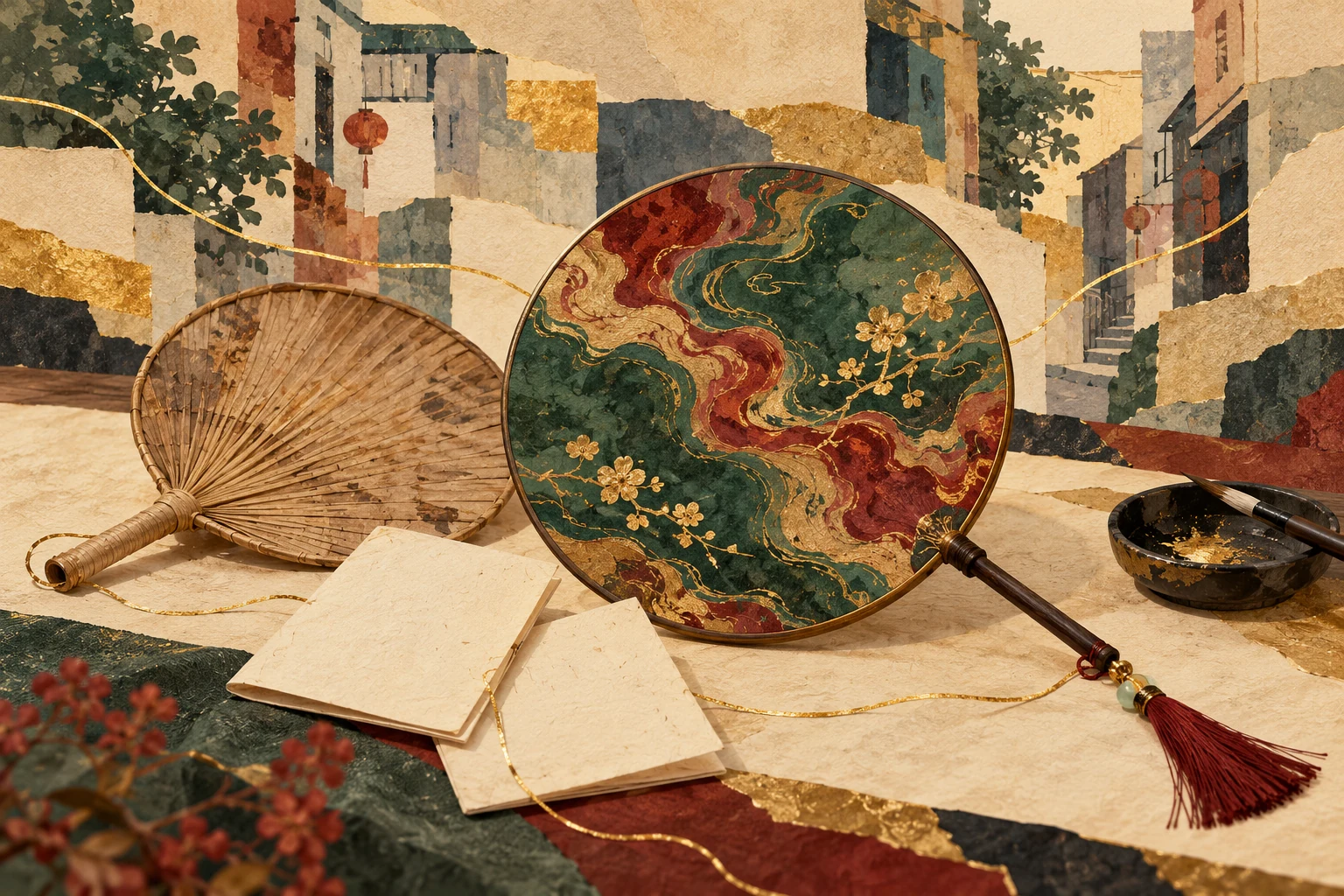
The illustrations are AI-made concept images of lacquer art round fans, palm-leaf fans, and abstract street scenes created for this project, presenting the themes of handcraft and community memory; they are not scenes from the Victoria Park carnival, actual views of Kwong Fuk Ancestral Hall, or demonstrations of standard rituals. The fan-surface textures in the images are not actual works from this booth and do not serve as technique instruction; no photos from media or event organizations have been reproduced.
常見問題
問Does this article indicate that the carnival is still open?
No. This article is a retrospective on a concluded event, not a real-time event notice; other dates and sessions must be checked separately with the organizer.
問Can any handcraft featuring Ji Gong elements be directly called a national-level intangible cultural heritage?
This cannot be inferred from a person or appearance alone. The item name, category, and scope of application in the register should be checked, and the elements used in the event should be distinguished from formal register items.
問How should the years 1856 and 1895 of Kwong Fuk Ancestral Hall be understood?
The official historical materials refer respectively to the first-generation temple and the existing reconstructed building; both should be stated together when citing, to avoid selecting only one of the years.
問Does "expelling pestilence" mean the ritual has a proven medical effect?
This article understands this name only in the context of traditional narrative and the event; there is no evidence that any ritual can prevent or treat illness, and personal health is not judged by belief.
資料來源
- Tung Wah Group of Hospitals: Tung Wah Group of Hospitals participates in the 2026 International Ji Gong Cultural Carnival · Original publication: 2026-10-26, no specific time stated; event: 2026-10-23 to 25. Accessed: 2026-10-27. A post-event retrospective by a participating organization; the organizer is Tung Tseng Yuen Buddhist Association; this article is not an on-site interview.
- Bastille Post: International Ji Gong Cultural Festival opens at Victoria Park, first palanquin-carrying competition re-enacts cross-harbour pestilence expulsion · Original publication: 2026-10-22 18:11; updated: 2026-10-23 11:40 (Hong Kong time). Accessed: 2026-10-27. Used to cross-check earlier arrangements such as event dates, venue, and organizer.
- China Intangible Cultural Heritage Network: The Legend of Ji Gong (Ⅰ-11) · Item announcement: first batch of 2006; the webpage does not state an article publication date. Accessed: 2026-10-27. Register item Ⅰ-11, folk literature, declared region Tiantai County, Zhejiang Province.
- Antiquities and Monuments Office: Heritage.Treasures-Kwong Fuk Ancestral Hall, embodying the deep blood ties of the Chinese people · Original article published in the 2025-04-03 "am730" column, official repost page. Accessed: 2026-10-27. Supports the first-generation construction in 1856, the reconstruction of the existing temple in 1895, and the community historical background.
- Antiquities and Monuments Office: Kwong Fuk Ancestral Hall · The page does not state a publication date. Accessed: 2026-10-27. Verify 40 Tai Ping Shan Street, Sheung Wan, the date of the existing building, and its designation as a monument in 2026.
- Tung Wah Group of Hospitals: Kwong Fuk Ancestral Hall formally declared a monument · Original publication: 2026-01-30. Accessed: 2026-10-27. An institutional announcement by Tung Wah Group of Hospitals on the designation of Kwong Fuk Ancestral Hall as a declared monument.