Hong Kong mahjong tiles on display at the Cultural Centre: understanding hand-carved intangible cultural heritage through knife marks and colour
KarmaSpace translation
The carnival has ended; the exhibition runs until 11-29
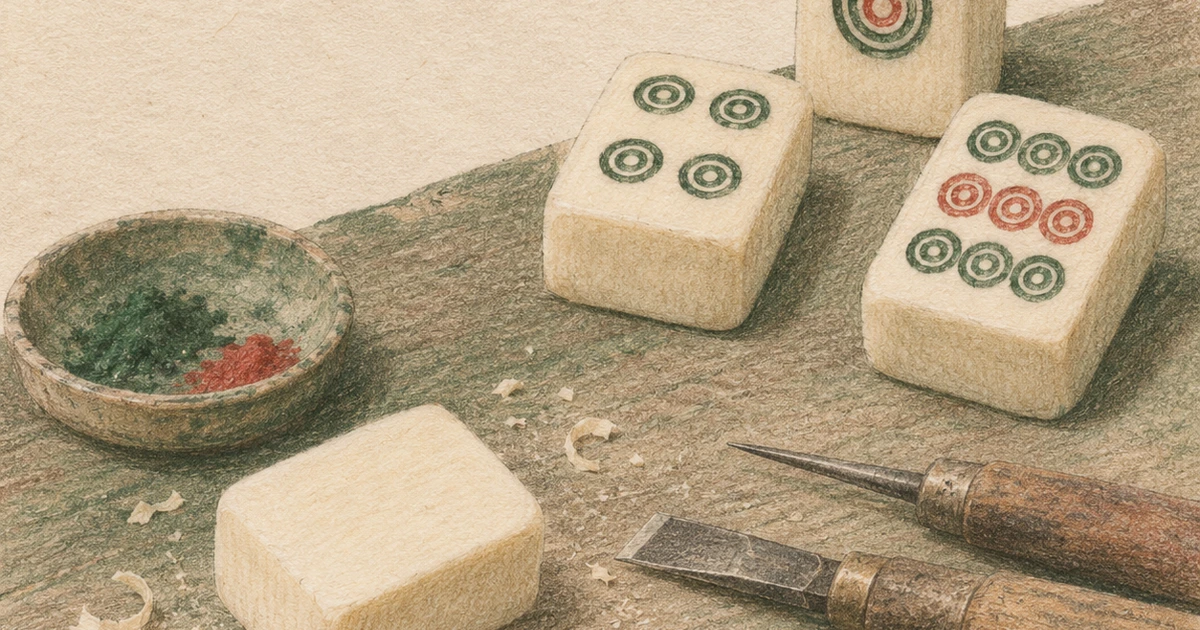
Illustration of tile blanks, carving knives and circle tiles. For the production process and exhibition-area arrangements, see LCSD information.
The Government issued a press release on 2026-11-22 at 19:26, confirming that "Asian Ethnic Cultural Performances +2026" was held at the Hong Kong Cultural Centre that day. The concurrent "Grand Ceremonies Showcase — Ethnic Cultural Exhibition" was on display in the Cultural Centre foyer from 22 to 29. The LCSD's Hong Kong exhibition-area information takes mahjong tile making as its theme, introducing the craft behind this everyday object. [Sources 1–3]
To understand hand carving at the exhibition, first look for the lines on the tile face, then see where the colour falls. A tile needs both a clear pattern and recognisability consistent with the rest of the set. Looking at two or three tiles of the same design makes it easier to notice how the craftsperson balances consistency and personal touch than admiring a single finely chiselled tile. This is the viewing approach suggested in this article.
From flat tile blanks to colouring the grooves
The LCSD explains that early Hong Kong tiles were sometimes made from wood or bamboo strips, and hand carving was also called "scraping bamboo"; later, acrylic was used. To make a tile, the raw material is first cut into blanks, then the tile face is polished before the characters and patterns are carved, and finally colour is applied. When observing, you can separately check whether the edges of the tile body are neat, how the grooves turn, and how the colour brings out the carved lines. [Sources 2, 4]
This year in 2, Ta Kung Pao interviewed hand-carving artisan Ho Sau-mei. She carves tiles in batches by type, then colours them batch by batch. This approach suggests that when looking at a work, besides noting individual knife marks, one can also ask which lines must stay consistent when the same design recurs, and which details leave room for the artisan's hand. LCSD information also notes that after machine carving became widespread, some artisans have continued the craft through workshops, souvenirs or custom designs. [Sources 2, 5]
How should the directions and auspicious phrases on the tiles be read?
The tiles include east, south, west and north, as well as a character tile commonly called "faat" (prosperity). Wind tiles are a tile category in mahjong rules. Seeing the character "faat", one can discuss the associations of abundance it evokes in everyday language. To interpret a particular pattern as a feng shui direction or a wish, one should still ask who made the design, where it was used when designed, and whether there is an exhibition label or artisan explanation. [Sources 2, 5]
The item named on Hong Kong's intangible cultural heritage list is the craft of making mahjong tiles. What it preserves is information on the processes, tools and how techniques are transmitted. Even if a custom work uses auspicious wording, its meaning can only be understood from its style, use and provenance. Tile faces cannot be used to predict visitors' wealth luck or the outcome of a game. [Sources 2, 4]
What can you look at first when you arrive?
The exhibition in the Hong Kong Cultural Centre foyer is open from 11-23 to 28, from 9 a.m. to 11 p.m., and on 29 from 9 a.m. to 5 p.m. Exhibits, display panels and one-off activities each have their own schedules. If you want to see craft demonstrations or photograph exhibits, check the organiser's arrangements first and note venue guidelines. [Sources 1, 3]
After your visit, you can read further: Sam Tung Uk "ICH Wonder Play" and Drawn-thread Figurines. The two crafts differ in materials and uses. When viewing exhibitions, you can start with three questions: who made it, how it is made, and on what occasions it is used.
Common questions
QOn which day does the mahjong tile exhibition end?
The Leisure and Cultural Services Department lists the exhibition period of "Gathering of Splendid Ceremonies" as running until 2026-11-29, with opening hours on that day until 5:00 in the afternoon.
QDo you need to know how to play mahjong before visiting the exhibition?
You can first look at the engraved lines, the colouring, and the subtle differences between tiles of the same design. These are observations that start from the making process.
QWhat is included in the Hong Kong intangible cultural heritage list?
The item is the craft of making mahjong tiles, covering processes such as tile blank processing, carving and colouring.
QCan the east, south, west and north and the "fa" on the tiles be used to judge feng shui or financial luck?
On the table, the direction characters are wind tiles used in the game. Custom works may also use text to express good wishes. To understand the meaning of a work, you can look into the designer and the context of use; the tile face itself provides no basis for predicting an individual's financial luck.
Sources
- Government press release | Asia+ Festival 2026 held and ethnic culture exhibition opens · Published on 2026-11-22 at 19:26 Hong Kong time, confirming that the carnival was held that day and that the lobby exhibition runs from 11-22 to 29.
- Leisure and Cultural Services Department Community Programmes Office | Hong Kong mahjong tile exhibition · The end of the page is marked 2026-11-17. It confirms the themes of the Hong Kong exhibition area, the tile materials, the production processes and the ways the craft has been passed on in recent years.
- Leisure and Cultural Services Department Community Programmes Office | Gathering of Splendid Ceremonies ethnic culture exhibition · The organiser's programme page, listing the venue and daily time slots from 11-22 to 29.
- Hong Kong Culture and Heritage Resource Centre | Craft of making mahjong tiles · Standing intangible cultural heritage information; the page does not list a publication time. It checks the intangible cultural heritage list number 5.61, the processes, and the production changes facing the hand-carving craft.
- Ta Kung Pao | The craft and transmission of a female hand-carved mahjong tile master · Published on 2026-2-19 at 04:23 Hong Kong time. The reporter interviews Ho Sau-mui, setting out her methods of carving and colouring tiles as an earlier example of a Hong Kong artisan.