When Feng Shui Meets AI: Turning Metaphysics into a Measurable, Verifiable Science of Living
KarmaSpace translation
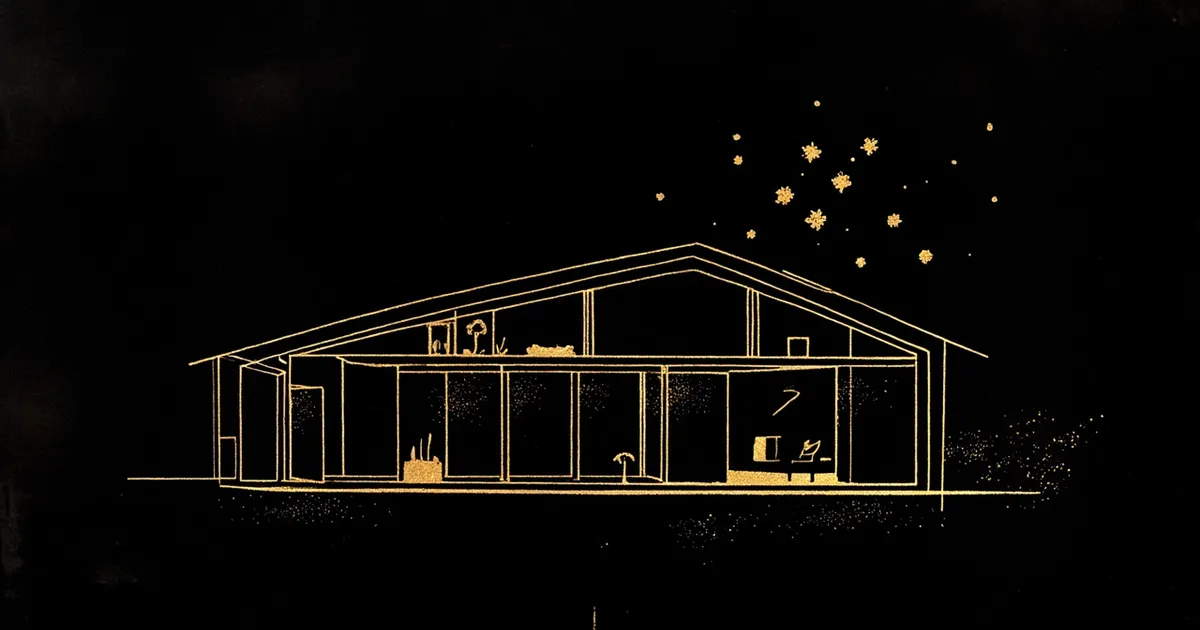
The relationship between feng shui and AI is to translate traditional feng shui concepts into measurable residential indicators: a through-passage sha corresponds to a short circuit of airflow, an open bright hall corresponds to daylight and view, and heavy yin energy corresponds to low illuminance, high humidity, and poor ventilation. The approach of 玄居 KarmaSpace is for users to scan their homes themselves with a phone AR, align to true north, overlay the Xuan Kong flying star chart on the real floor, and then have a certified master review it remotely.
Feng Shui has circulated in Chinese societies for more than a thousand years. Critics call it metaphysics, supporters regard it as wisdom, and both views are in fact half right: the essence of Feng Shui is the systematic observation by people of old, in an age without instruments, of how humans can live healthily and securely, except that the language it uses is that of trigrams and directions rather than data.
Once this language is translated into modern indicators, one finds that the questions it cares about overlap heavily with today s healthy building science.
Most traditional Feng Shui concepts can be translated into measurable indicators
A piercing-hall sha, where the main door faces the back door or a window directly, is traditionally described as being unable to store qi. In modern terms, it is a short circuit of airflow: air flows straight out without circulating through the interior, temperature and humidity are hard to stabilize, and the felt experience is naturally poor.
An open bright hall, with no obstruction before the window, corresponds to daylight illuminance and openness of view, both of which are directly related to mood and circadian rhythm.
Heavy yin energy refers to a space with long-term low illuminance, high humidity and poor ventilation, where mold easily grows and air quality is poor. The ancients used the single word yin to sum up an environmental problem that today requires three kinds of sensors to measure fully.
This is precisely what international healthy building certification has been doing in recent years: setting measurable, verifiable standards for living environments. Feng Shui and modern building science in fact care about the same thing; the difference lies only in that the former generalizes from experience while the latter measures with instruments.
Our approach: scan it yourself in AR, and lay the flying stars back onto your own floor
In the AR survey module of KarmaSpace, you scan your home space with your own phone, it automatically aligns to true north, and then spreads the Xuan Kong flying star chart in 3D across the real-scene floor. The nine palaces are no longer squares on paper but markers pinned to the actual positions of your living room and bedroom, and they stay fixed to the floor as you rotate the view.
After scanning is complete, a certified master views your 3D real-scene model remotely, examining the star combinations of each direction and the five-element interactions of each object one by one within the real scene, all without anyone needing to visit in person. The survey report is archived together with the model, so that when furniture is moved later or layouts are compared, there is a basis to rely on, rather than the master said so and that is that.
Homes set according to the person: a closed loop between destiny analysis and Feng Shui
The same house brings different fortune and misfortune to different people. This is the core claim of the traditional Feng Shui life gua, and it is also the element most often overlooked in generic Feng Shui articles in circulation.
We have made this into a product workflow: a free chart calculation works out the favorable and unfavorable five elements of the BaZi and the east-four or west-four life gua; when the master remotely surveys your real-scene model, personalized layout suggestions are given on this basis, rather than one set of statements applied to everyone. Destiny analysis and Feng Shui are joined here into a single closed loop.
AI interpretation, where every sentence has a classical source
The platform s AI interpretation cites original passages from classical texts such as Di Tian Sui, Qiong Tong Bao Jian and Zi Wei Dou Shu Quan Shu, with more than two hundred entries checked word by word against public classical libraries. The judgments are not the model s feelings but arguments with sources, such as Qiong Tong Bao Jian says: for yi wood in the ninth month, roots withered and leaves fallen, it must rely on gui water for nourishment.
The BaZi and Zi Wei systems are reconciled against each other: when conclusions agree, mutual corroboration is explicitly noted; when they conflict, this is honestly marked rather than glossed over. Only an interpretation that can be examined is worth trusting.
Conclusion
Feng Shui needs neither to be deified nor stigmatized. Re-measuring, verifying and personalizing a thousand years of environmental observation with modern tools is our answer to Feng Shui meets AI.
常見問題
問How should a through-passage sha be understood in modern language?
A through-passage sha is when the main door directly faces a back door or window; the traditional saying is that it cannot store qi. Described in modern language, it is a short circuit of airflow: air flows straight out without circulating through the interior, and temperature and humidity are hard to keep stable.
問What does the feng shui term heavy yin energy refer to?
Heavy yin energy roughly corresponds to a space with long-term low illuminance, high humidity, and poor ventilation; such spaces easily breed mold and have poor air quality. The ancients used the single word yin to sum up environmental problems that today require several kinds of sensors to measure fully.
問Does AR feng shui surveying require a master to visit in person?
No. Users scan their homes themselves with a phone, and the flying star chart aligns to true north and overlays on the real floor; after the scan is complete, a certified master reviews the 3D model remotely, examining each direction one by one.