Bedroom colors and the five elements: try the color first, then decide whether to repaint an entire wall
KarmaSpace translation
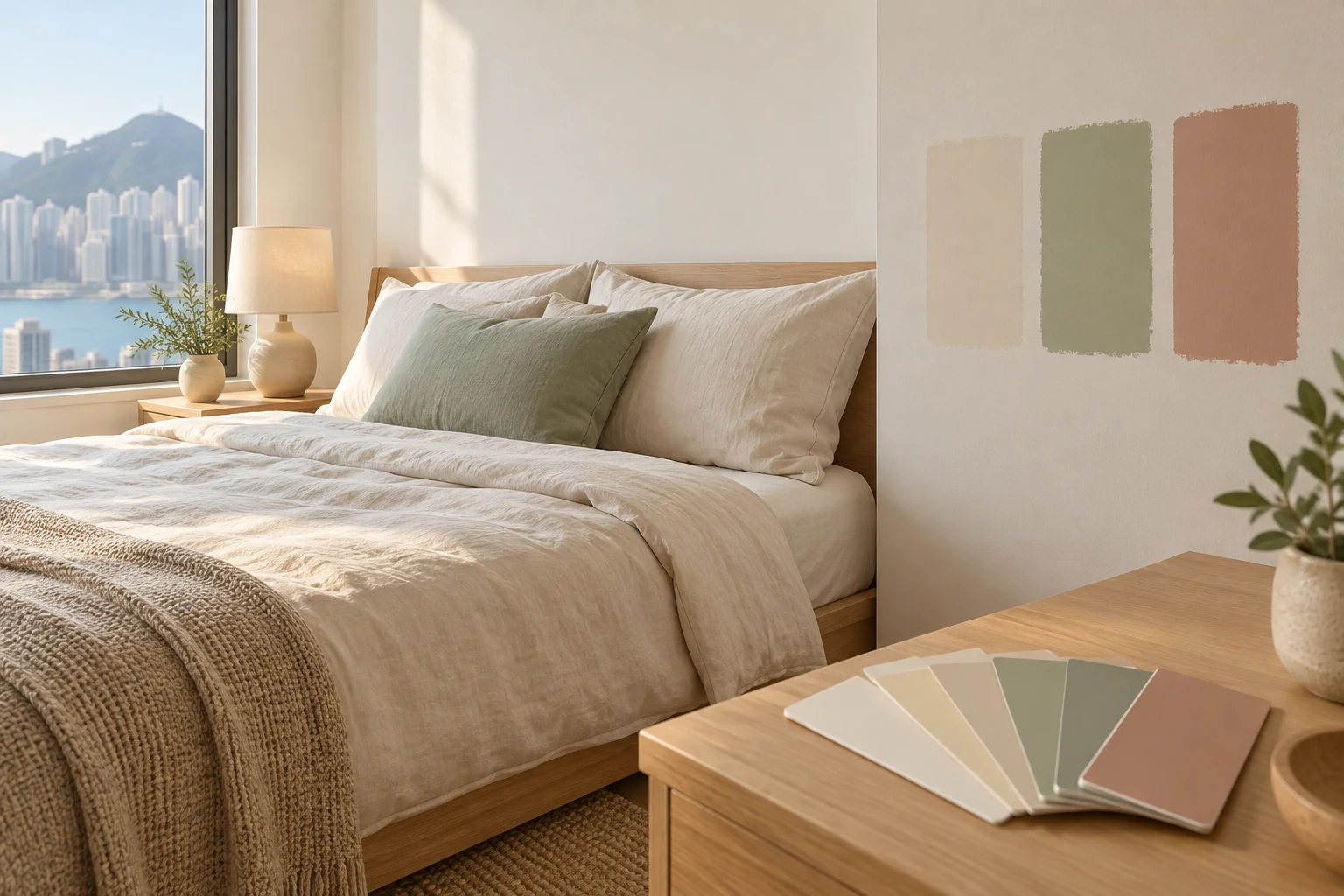
Questions about room colour usually involve more than one issue
Behind "what colour should my room be?" there may be three different things: wanting a certain traditional meaning, wanting to change how the room feels, or preparing to repaint. Clarify the purpose first, so that a single five-element colour chart is not made to stand in for personal preference, material choice and work scheduling all at once.
A practical starting point is to look first at the existing bed, wardrobe and floor: which will stay, and which can be changed? If most of the furniture stays, the wall colour needs to be compared alongside it. Looking only at colour blocks on a phone, or remembering only a recommended colour name, may not let you see in advance how the finished room will look.
The five colours have a cultural context, but they are not modern paint colour codes
A press release from the Hong Kong Museum of Art introducing the colours of cultural relics in 2021 mentions that in ancient China colours were divided into five major categories — blue-green, red, yellow, white and black — known as the five correct colours, and that the colours used on objects were also linked to taste, belief and ritual systems. This helps explain why traditional colours were not merely decorative, but it cannot be inferred from this that a particular wall paint will bring a specific fortune. What is cited here is historical and cultural material, not information about a current exhibition.
When five-element colour schemes are used as home advice, the basis for the judgment should also be clarified: is it an individual's chart, the room's orientation, or purely symbolism used as design inspiration? These starting points cannot simply be mixed. Grey-green, yellow-green and deep green, all called "green", do not produce the same physical effect either; traditional categories do not choose the modern paint's colour code, sheen and coating for you.
A chart showing a missing element does not mean the whole room needs a compensating colour
Seeing that one item on a chart is low and then painting the whole room in the corresponding colour jumps straight from classifying data to a purchasing decision. The count of the five elements is not the same thing as an overall judgment in destiny analysis, nor can a wall be treated as a tool for changing a chart. You may first read The difference between missing five elements and favourable elements in BaZi to clarify what the chart's counts mean.
If you like a certain traditional colour scheme, you might first treat it as a design constraint: for example, use it only on cushions or a small hanging picture, and see whether you are willing to live with it every day. This test answers whether you like it and whether it goes well together; it is not verifying fortune. In a shared bedroom, the feelings of the other user should be included in the decision even more.
When testing colours, let the swatches stay with the room through day and night
First choose a small number of candidate colours, and prepare comparable test patches according to product and applicator recommendations, placing them near the furniture, curtains and bedding that will stay. View them in daylight, after turning on the lights, and at the times you usually use the room. Recording which one you like and which angle looks too dominant makes it easier to narrow the choice than repeatedly asking which colour name is most auspicious.
Then distinguish by area: a single swatch, a cushion and a whole wall carry different visual weight. If you are still undecided, you can first change bedding or small items that are easy to restore. Photographs help preserve comparisons, but screens and cameras alter colour rendering, so in the end you should return to the physical object, the on-site light and the actual coating.
After choosing the right colour, you still need to choose the right materials and work arrangements
The Indoor Air Quality Information Centre lists building and renovation materials, new furniture and other possible pollution sources, and notes that poor ventilation allows pollutants to accumulate. The Centre's improvement suggestions include choosing products with low or no volatile organic compounds and maintaining adequate ventilation. These are matters of materials and the use environment, a different level from whether the wall is off-white or blue.
Confirm with the applicator the suitable substrate, product information, drying requirements and ventilation arrangements; do not ask only about the colour code. This article does not provide a universal answer that "after painting, you can definitely move in after a certain number of days"; products, scope of work and environment differ, so arrangements should follow product instructions and appropriate professional advice. A subjective impression of low odour does not mean air quality testing has been completed.
How to compromise in a shared room? Start by separating large areas from accents
If one person likes dark colours and another likes light colours, you can first use a colour family that is easier to agree on for the walls, then add different preferences through bedside small items that each person can choose. If a family member particularly cares about five-element meanings, first confirm whether they care about the overall tone or symbolic accents, then discuss a proportion everyone is willing to keep, rather than escalating the disagreement into whose destiny chart overrules whose.
If the real problem is direct light, light from outside the window or interference near the door, changing the wall colour may not address it. You may also read Common problems with bed placement and check placement and colour use separately. Changing only a small number of items at a time makes it easier to know which one has actually improved daily use.
A simple record of colour scheme decisions
Finally, keep four pieces of information: the purpose of the colour choice, the furniture being kept, the results of day and night colour testing, and the product and work arrangements. If traditional colour advice was used, also note its basis for judgment and what remains unconfirmed. When you want to adjust things later, you will not need to start again from "which colour is best".
This article was prepared by the 玄居 KarmaSpace editorial team, with AI-assisted research and writing; the accompanying image is an original illustration of a colour-testing scene and is not a specified colour code, product recommendation or photograph of completed work acceptance. Colour can carry personal and cultural meaning; this article does not use it to guarantee sleep, health, relationships or financial outcomes. Information was consulted on 2026-10-30.
常見問題
問Must a bedroom use light colours?
There is no single answer that suits everyone. First look at the room's light, the furniture being kept and the users' preferences, then compare physical colour samples; you can also use a dark colour you like only in a small area.
問If the BaZi (Four Pillars) chart lacks wood, does the room have to be painted green?
You cannot directly derive the wall colour of an entire room from counting the five elements. First distinguish between what is missing and the overall favourable-use assessment; if it is merely a liking for the symbolism of green, you can first try it out with small items that are easy to revert, without treating it as a method for changing your fate.
問The colour card looks good, but it is different once painted on the wall — how can the discrepancy be reduced?
Place the candidate colours in the actual room, together with the existing bedding, flooring and lighting, and compare them at different times of day. Screens and photographs are only suitable as supporting records; in the end you still need to look at the physical object and the actual coating.
問Does low-VOC paint mean no ventilation is needed?
No. Material selection and ventilation should be considered together, and arrangements should follow the product instructions and the construction environment. This article does not use colour, odour or a single product label as a substitute for air quality assessment.
問Can changing the wall colour guarantee better sleep or improve relationships?
It cannot be guaranteed. Colour schemes can be adjusted according to personal preference, but if the distress comes from lighting, noise, daily routine or interpersonal problems, the corresponding causes still need to be addressed; you cannot rely on changing a colour alone.
資料來源
- Hong Kong Government Press Release: New Hong Kong Museum of Art exhibition leads audiences into the world of colour in Chinese cultural relics · Published 2021-11-03 19:55 Hong Kong time; accessed 2026-10-30. Supports only the historical and cultural background of the five correct colours and the colours used on objects; does not cite past exhibition periods or the admission measures of those years as current information, and does not support feng shui or health efficacy.
- Indoor Air Quality Information Centre: Sources of indoor air pollutants · Government indoor air quality educational material; the main text of the original page does not state a first publication date; accessed 2026-10-30. Supports background on pollution sources such as renovation materials, new furniture and poor ventilation.
- Indoor Air Quality Information Centre: Recommendations for improving indoor air quality · Government improvement recommendations; the main text of the original page does not state a first publication date; accessed 2026-10-30. Supports low- or no-VOC products, controlling pollution sources and maintaining ventilation; does not provide a general number of days to wait before moving in.